

Key takeaways
- Manual quality assurance has always covered only a small sample of conversations, never all of them.
- The point of AI quality monitoring is not to control more. It is to replace control with coaching.
- Analyzing every recorded conversation reveals root causes that a sample cannot show.
- The manager’s role shifts from after-the-fact checking to targeted support.
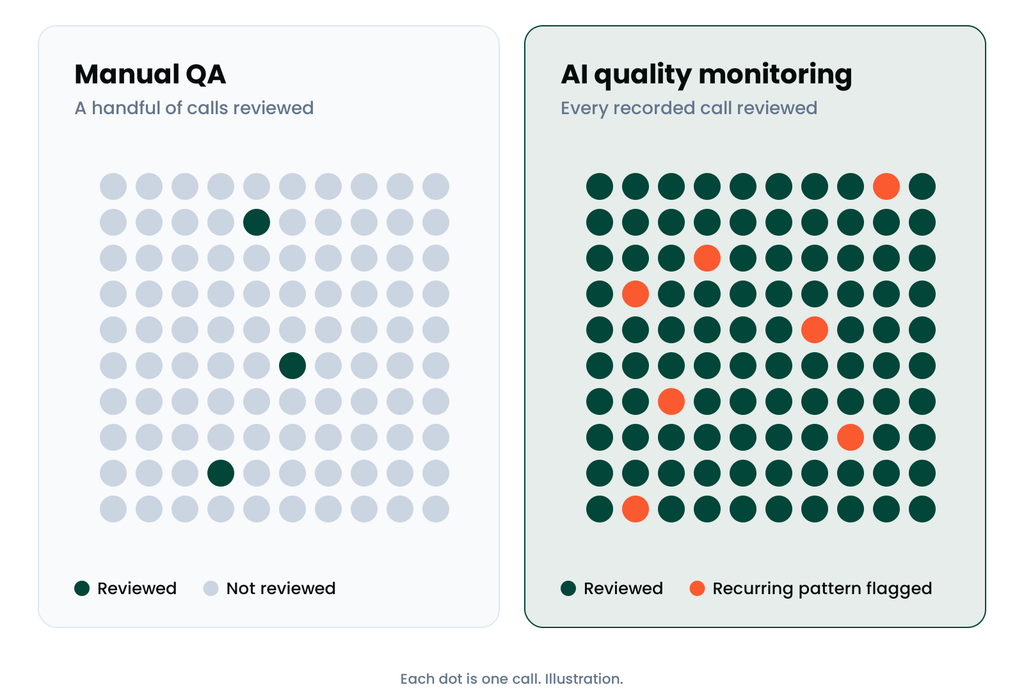
In most contact centers, quality assurance relies on manually listening to a small number of calls per agent per month, often picked at random or flagged by an unhappy customer. Specialist quality monitoring vendors (Verint, Modulate) put manual coverage at 1 to 5% of calls, which leaves the vast majority of conversations unchecked. A recurring problem can go unnoticed for weeks, simply because it did not fall into that month’s sample.
This guide explains what AI conversation analytics changes about that blind spot, for whom, and under what conditions.
What is quality monitoring?
Quality monitoring is the practice of assessing the quality of customer interactions: following procedures, giving accurate answers, tone, regulatory compliance. AI conversation analytics automates part of it at scale, spotting gaps, recurring patterns and coaching opportunities across all recorded conversations rather than a sample.
The two terms are not strictly synonyms. Quality monitoring is the practice. AI conversation analytics is one way to carry it out, and the most complete one to date.
| Manual QA | AI quality monitoring | |
|---|---|---|
| Coverage | A small sample | All recorded conversations |
| Evaluation | Human listening, scorecard applied with judgment | Scorecard applied automatically and consistently |
| Main use | Control, after-the-fact detection | Continuous analysis, coaching |
| Main limit | Volume and evaluator availability | Scorecard quality and interpretation of results |
What are the use cases for AI quality monitoring?
Move beyond the sample. Every recorded conversation is evaluated automatically, instead of a few calls per agent in a classic manual approach. An agent with a recurring weak spot on a specific type of request no longer has to wait to land in the monthly sample to be noticed.
Detect root causes. Spot recurring patterns across all conversations: the same customer irritant on a given product, the same misunderstanding of a procedure after a script change.
Structure coaching. Build targeted action plans from real conversations rather than isolated cases surfaced by chance, and track progress over time.
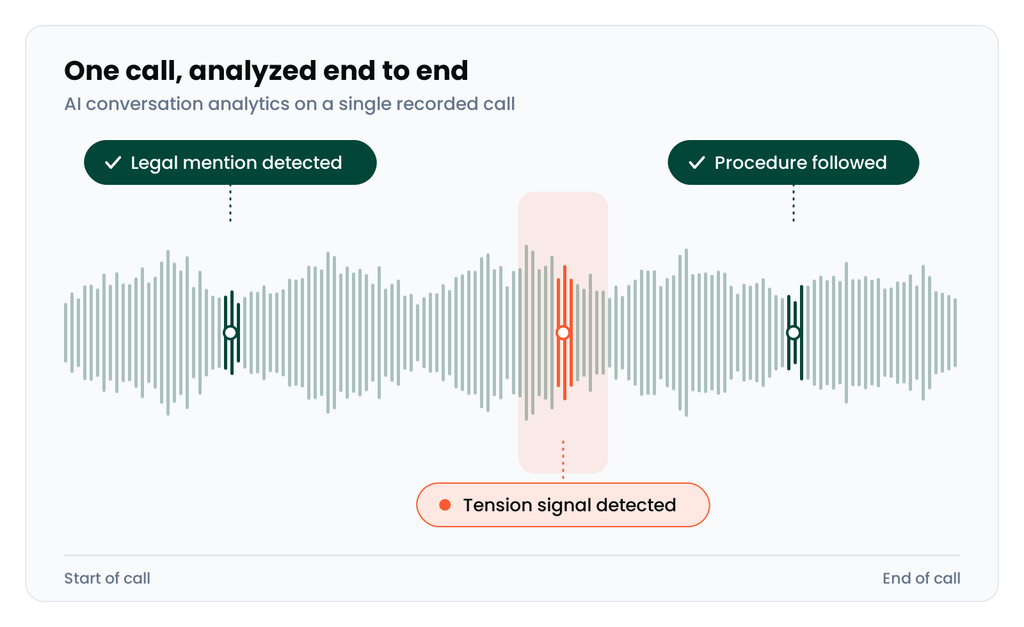
Secure compliance. Systematically check mandatory points (legal mentions, consent, regulated procedures) and get an alert shortly after the call, rather than discovering a gap weeks later.
What AI really changes: from control to coaching
Manual QA has a structural limit: it can only cover a sample, and it always comes after the call. When analysis covers all recorded conversations, the question changes. It is no longer only “was this call compliant?” but “which patterns come up most often, and for whom?”
In practice, a manager who used to receive an occasional evaluation form now gets an overview: the patterns that come up most in their team, and the agents who are improving on a given point. This shift does not happen automatically with the tool. It requires management to change its practice, not just its software, and that adjustment time is often underestimated in deployment projects.
How to deploy AI quality monitoring smoothly
AI quality monitoring cannot be improvised as an off-the-shelf tool. It is a project that touches technology, management practices and team trust. Five steps usually structure a deployment that works.
1. Lay the technical foundations. Check that the solution can connect to your existing CCaaS (contact center as a service) platform and CRM. Start with one mature channel (voice or chat) rather than opening everything at once. Handle GDPR compliance upfront: automatically mask sensitive personal data (card numbers, passwords, addresses) before conversations are analyzed, working with your data protection officer. EU hosting makes compliance easier but does not guarantee it on its own. Data masking and access governance are still needed wherever the data is hosted.
2. Start with a limited scope. Tracking fifty quality criteria from day one drowns managers in alerts. It is better to target three to five critical points and set a concrete goal for each.
3. Co-build the approach with frontline teams. A tool presented as a surveillance system will be worked around. Stating in writing that the tool is for self-coaching and support, not individual sanctions, changes how it is received. Managers also need training for their new role: less manual listening, more interpretation of dashboards to run fact-based coaching conversations.
4. Pilot before scaling. A volunteer team, for a few weeks, lets you calibrate the tool on real cases. At the start, a tension-detection AI may mistake irony for anger or miss an implicit intent. This phase is used to adjust those thresholds before a wider rollout.
5. Scale gradually and close the loop. Roll out in waves, with review routines that bring the findings into team meetings. Recurring patterns should also be passed on to the teams that can act on them outside the contact center.
How to measure the success of a deployment
Results fall into three categories, best tracked together rather than separately.
Operational: volume of conversations actually audited, after-call work time, and the manager time freed from manual listening and reassigned to coaching.
Compliance and risk: the rate of mandatory mentions respected across all calls, and the ability to pinpoint why a callback reason keeps recurring, instead of just noting that it exists.
People: fewer disputes in coaching sessions, replaced by discussions built on shared facts, and training targeted at real gaps rather than generic programs.
A deployment that improves productivity without ever measuring its human impact risks missing the most important signal: how the tool is experienced by the teams it is meant to help.
Which KPIs should you track for contact center performance?
The most commonly tracked metrics are still FCR (first contact resolution), AHT (average handling time), CSAT (customer satisfaction) and NPS (Net Promoter Score). AI quality monitoring does not replace them. It feeds them with more complete data, by cross-referencing the conversation quality score with the satisfaction actually expressed in the exchange, across all calls rather than only survey respondents.
What are the limits of AI quality monitoring?
- A score is not a diagnosis. Knowing that a conversation scored poorly does not automatically tell you why. The analysis needs to be paired with human review of the most significant cases.
- The scorecard remains a human choice. AI applies a scorecard consistently, but it does not decide on its own what counts as a good answer. Two human evaluators can legitimately disagree on the same call, which makes it even more important to define the scorecard collectively before any technical setup. A badly designed scorecard applied by AI produces an evaluation that is consistent and wrong at scale, and harder to correct than an inconsistent manual one, precisely because it looks rigorous.
- The risk of over-control. Analyzing every conversation must not mean more pressure on agents. The goal remains coaching, not generalized surveillance.
- Management adoption. This transition needs support over time, not just a technical rollout followed by a one-day training.
These limits do not undermine the value of conversation analytics at scale. They explain why the strongest deployments keep human oversight on the scorecard and on how results are interpreted.
How does AI quality monitoring fit into your existing stack?
Before choosing a solution, check what it forces you to change. A quality monitoring tool should build on the recordings and data your contact center already produces, not impose a new recording chain.
A solution like SquAire Performance is designed to integrate with existing CCaaS platforms rather than impose its own.
Key points to remember
- Manual QA has historically covered only a small sample, never all conversations.
- AI quality monitoring analyzes all recorded conversations and detects root causes invisible at sample scale.
- The goal is not to control more, but to turn control into targeted coaching.
- An effective deployment starts with the scorecard, is calibrated on a limited scope, and supports managers first.
- Integration generally happens without replacing the existing CCaaS infrastructure.
FAQ
What is quality monitoring in a contact center?
Quality monitoring is the assessment of customer interactions against a defined scorecard (procedures, accuracy, tone, compliance), traditionally done by manually listening to a sample of calls.
How can you analyze all conversations instead of a sample?
By automating the evaluation with AI, applied consistently to all recorded conversations, instead of having a quality analyst manually listen to a limited number of calls.
What is the difference between manual QA and AI quality monitoring?
Manual QA covers a small sample and happens after the call. AI quality monitoring covers all recorded conversations and detects recurring patterns, not just isolated cases.
How does quality monitoring feed agent coaching?
By identifying precise patterns from real conversations, which makes it possible to build targeted action plans per agent and track progress over time.
Which KPIs measure contact center performance?
The most common are FCR, AHT, CSAT and NPS. AI quality monitoring enriches them with data covering all calls.
Can AI quality monitoring work with my existing CCaaS platform?
Generally yes. A solution like SquAire Performance is designed to integrate with existing CCaaS platforms rather than replace them.
Go further
Want to understand how to move from quality control to coaching at scale? Discover SquAire Performance.