

Key takeaways
- AI in customer service supports agents more than it replaces them.
- An Agent Assist works alongside the agent; a chatbot talks directly to the customer.
- The gains cover quality and compliance as much as productivity.
- A gradual integration is generally possible without overhauling the whole IT system.
In many contact centers, agents juggle several tools, have to find the right information fast, apply procedures that change often, and absorb a growing administrative workload after every call.
These are the pain points where AI often adds the most value in customer service: not necessarily by replacing the agent, but by removing what stops them from focusing on the relationship itself.
What is AI in customer service?
AI in customer service covers several distinct uses: real-time assistance for agents (Agent Assist), automatic analysis of conversations after the fact (quality monitoring, detection of tension signals), and automation of tasks with no human involvement (chatbots, RPA, or robotic process automation).
The most common confusion is to reduce AI in customer service to chatbots. In most enterprise deployments, the most mature use today is Agent Assist: an AI that works alongside the agent, not in their place.
What are the most common AI use cases in customer service?
An agent rarely thinks in features. They think in problems. Here are the AI use cases grouped by the pain points they actually address.
Reduce the administrative workload. Automatic summary of the history before the conversation, summary of the conversation afterwards to cut after-call work time, faster information search during the call.
Secure interactions. Real-time checking that procedures and compliance points are followed, and detection of risk signals (complaint, potential dispute) during the conversation rather than afterwards.
Strengthen the agent’s capability. Suggested replies or actions adapted to the context, and easier access to knowledge during the call rather than after it (see SquAire Knowledge).
Speed up ramp-up. Support for new agents, who rely on the AI’s suggestions during their first months to become autonomous faster, without waiting months for field experience.
In practice, the difficulty is never generating suggestions. It is delivering the right recommendation at the right moment, without turning the Agent Assist into a second screen the agent has to watch on top of the conversation itself.
That tension between technological power and real usefulness says a lot about what AI really changes in this job.
What AI really changes: human value shifts
An Agent Assist, by definition, assists: its purpose is not to replace the agent. But AI gradually changes what is expected of them.
What used to be “searching”, “typing” and “checking” is increasingly automatable. What remains deeply human shifts toward something else: making a call on a complex situation, reassuring a customer, handling ambiguity, carrying the relationship over time.
This is the key distinction between an AI project built with frontline teams, where human value shifts toward what matters most, and an AI project built only around a headcount-reduction goal, which delivers neither the same adoption nor the same results.
Chatbot, voicebot, Agent Assist, Knowledge AI: don’t mix them up
These four technologies are often mentioned together, even though they do not serve the same person.
| Technology | Interacts with |
|---|---|
| Chatbot | The customer |
| Voicebot | The customer |
| Agent Assist | The agent |
| Knowledge AI | The agent |
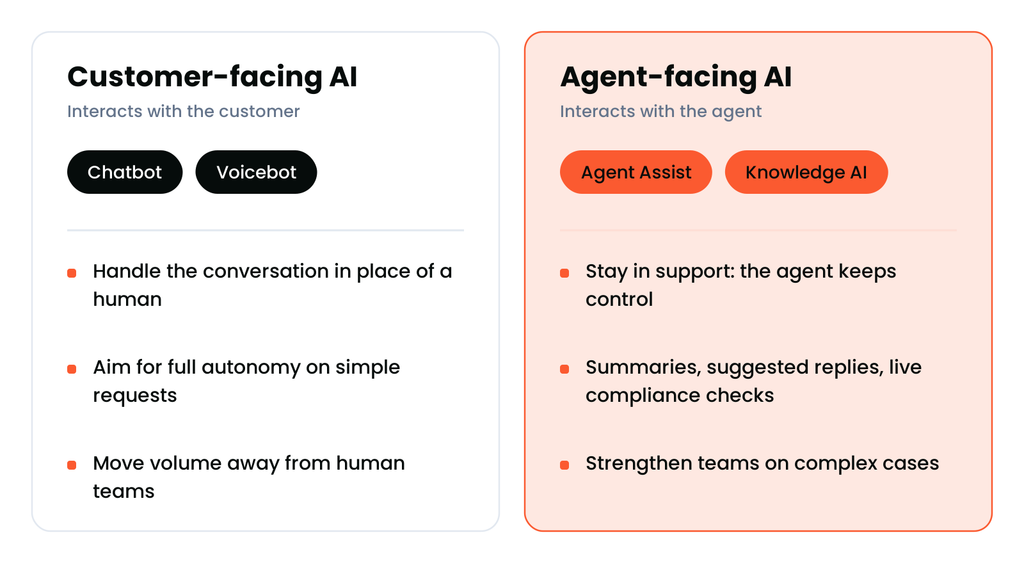
A chatbot or voicebot handles a conversation in place of a human, aiming for full autonomy on simple requests. An Agent Assist or a knowledge AI stays in support of the agent, who keeps control of the exchange with the customer: automatic summary of the history and context, suggested replies during the exchange, live compliance checks, and flagging of a key moment (complaint, sales opportunity, churn risk).
The difference is not only technical, it is organizational too: a chatbot moves volume away from human teams, while an Agent Assist strengthens those teams’ ability to handle more complex cases, faster and with fewer errors.
When should a conversation be transferred to a human agent?
In an architecture where a first conversational layer (chatbot or voice AI) coexists with human agents, routing relies on several signals analyzed continuously: the complexity of the request, an intent outside the covered scope, and tension signals in the exchange (certain words used, a change in the pace of the conversation).
A change-of-address request can be handled automatically from start to finish, while a complex complaint or an obviously unhappy customer is routed to an agent. The same tension signals, used after the fact rather than in real time, also make it possible to spot a deteriorating situation earlier across all conversations, not only those that surface through complaints.
How does an Agent Assist create value?
An Agent Assist generally creates value through three complementary mechanisms, not through a single isolated indicator:
- Less time spent on administrative tasks, through automatic summaries and shorter after-call work, which frees up time for the conversation itself.
- Fewer errors and compliance risks, through real-time checking rather than after-the-fact control.
- Faster ramp-up for teams, with new agents relying on suggestions during their first months (knowledge is covered in SquAire Knowledge).
The economic impact of an Agent Assist therefore does not come only from raw productivity gains. It also comes from better operational quality and compliance. And it comes from teams’ ability to handle more complex situations, an effect that does not always show up in volume figures. This is an important difference in mechanism with a chatbot, whose value is measured first in deflected volume.
What are the limits of AI in customer service?
Honest content on AI in customer service must also name its limits, not just its benefits.
- Hallucinations. A generative model can produce information that sounds plausible but is wrong if it is not anchored in verified sources. An AI is never better than the knowledge it accesses: if the knowledge base is outdated or contradictory, the AI will reproduce the same difficulties as the agent, or even amplify them.
- Suggestion overload. An agent cannot analyze five recommendations at once while talking to a customer. The point is not to offer more information, it is to offer the right information at the right time, which requires design work upstream, not just a high-performing model.
- Governance. Without a clear framework on who validates the embedded compliance rules and on what the AI may suggest or decide, the risk of drift grows with usage.
- Human oversight. An AI left unsupervised on sensitive cases (complaint, dispute, personal data) exposes the company to reputational and regulatory risk. An assistant that invents information or uses a tone that does not fit the brand can cost more in customer trust than it earns in productivity.
These limits do not call into question the value of AI in customer service. They explain why an effective Agent Assist deployment keeps a human agent as the decision-maker on the final interaction, and relies on models whose sources and hosting are controlled, in line with European regulatory requirements (GDPR, AI Act).
Agent Assist and existing systems: how does integration work?
Before choosing a solution, check what it forces you to change. An Agent Assist must fit into the agent’s working environment, not impose a new ecosystem.
A solution like SquAire Agent Assist is positioned as a widget compatible with the main CCaaS (contact center as a service) platforms and CRM (customer relationship management) systems on the market, so you keep your existing infrastructure and add the AI assistance layer on top, with no heavy migration.
This is also why an Agent Assist project often starts, even before the technology choice, with work on the quality and structure of the available knowledge: without that step, even the best tool will have nothing reliable to suggest.
Key takeaways
- AI in customer service covers several complementary technologies, not just one.
- An Agent Assist supports agents without replacing them; a chatbot interacts directly with the customer.
- AI does not only save time: it shifts human value toward judgment, relationship and handling ambiguity.
- An effective Agent Assist deployment keeps a human agent as the decision-maker on the final interaction.
- A gradual integration is possible without replacing existing tools.
FAQ
What is an Agent Assist?
An Agent Assist is an AI solution that supports an agent in real time during a customer interaction, providing summaries, suggested replies and compliance checks, without handling the conversation in the agent’s place.
How does real-time AI assistance work during a call?
It continuously analyzes the conversation flow (voice or text) to identify the context, the customer’s intent and the tone of the exchange, then pushes relevant information or suggestions to the agent at the right moment, without interrupting the conversation.
Does an Agent Assist replace agents?
No. An Agent Assist is designed to support the agent, who keeps the final decision on every interaction. That is the structural difference with a chatbot, which is built for full autonomy on simple requests.
What results can you expect from an Agent Assist deployment?
A shorter after-call work time, a better compliance rate, a faster ramp-up for new agents, and an indirect positive impact on customer satisfaction.
How does an Agent Assist integrate with an existing CCaaS?
Through a platform-agnostic widget compatible with the main CCaaS and CRM platforms on the market, with no need to migrate the existing infrastructure.
Go further
Want to understand how an Agent Assist can fit into your existing CRM or CCaaS environment? Discover SquAire Agent Assist.