

Key takeaways
- The problem is rarely a lack of customer feedback: the data already exists, scattered across surveys, reviews, complaints and conversations.
- The real challenge is connecting that feedback to concrete decisions, not just collecting it.
- Voice of the Customer differs from quality monitoring: one aggregates signals to inform a business decision, the other evaluates a conversation to coach an agent.
- A Voice of the Customer program that stays in a dashboard without ever changing a decision has not achieved its goal.
In most companies, customer feedback already exists in abundance: satisfaction survey responses, online reviews, complaint tickets, verbatims from conversations. The problem is almost never a lack of data. It is that this data stays scattered across teams, in different formats, and is never connected to answer one simple question: why are our indicators moving?
Take a simple example, for illustration. Complaints are rising on a given product, and a satisfaction survey shows a drop in CSAT (customer satisfaction score) on that same product, with no explanation. As long as these two signals sit in two separate dashboards, nobody connects them. That link between customer feedback and decision is what defines a successful Voice of the Customer program, more than the volume of data collected.
What is Voice of the Customer?
Voice of the Customer (VoC) is the set of feedback customers express through the channels the organization covers: satisfaction surveys, online reviews, complaints, verbatims from contact center conversations, and social media. A VoC program organizes these signals to understand expectations, pain points and reasons for contact, so it can guide product, marketing or operational decisions.
It is not the same as contact center quality monitoring. Quality monitoring evaluates a conversation to produce a quality score and an individual coaching plan (see our guide to AI quality monitoring and conversation analytics). Voice of the Customer aggregates signals from several sources to answer a question asked at company level rather than agent level: what really drives our customers to contact us, stay, or leave?
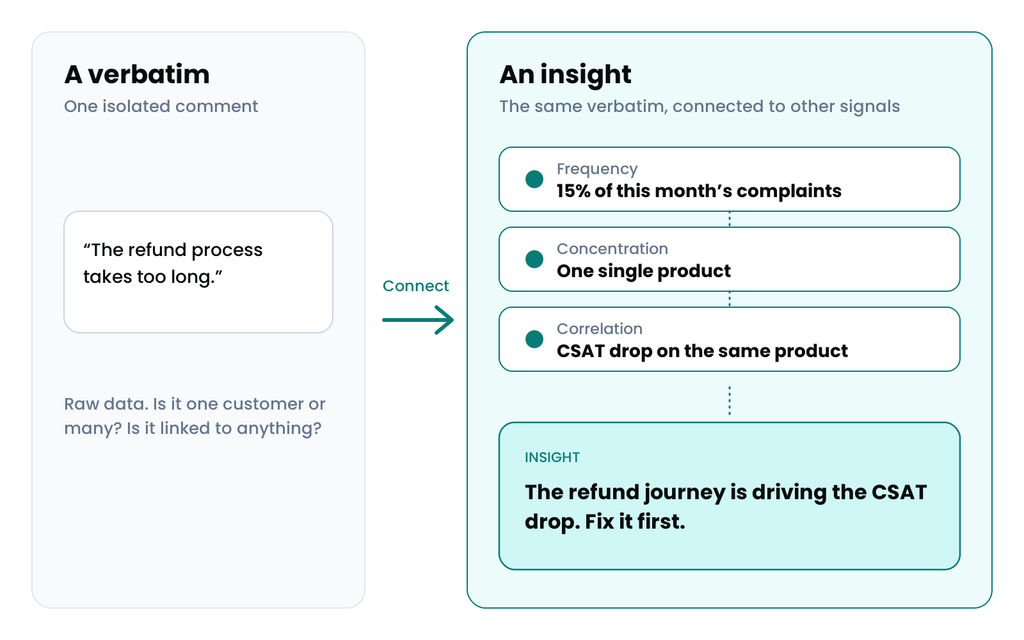
Nor is it the same as raw data. A verbatim (“the refund process takes too long”) is a data point. An insight is what you get once it is connected to other signals: the same reason appears in 15% of this month’s complaints, is concentrated on a single product, and coincides with the CSAT drop seen elsewhere. That connection turns an isolated verbatim into information you can act on.
Which feedback sources should you combine?
A VoC program usually draws on several complementary sources, which are better cross-referenced than multiplied separately: satisfaction surveys (CSAT, NPS, or Net Promoter Score), online reviews, complaints and support tickets, verbatims from contact center conversations, and sometimes social media.
Taken alone, each source gives a partial view. A survey says a customer is unhappy, rarely why. A complaint says why one specific customer got in touch, rarely whether the case is isolated or representative. Cross-referencing the sources is what separates a one-off case from a structural pattern. Back to our opening example: it is by linking the rise in complaints to the CSAT drop on the same product that an isolated signal becomes a priority issue.
How do you go from verbatim to decision?
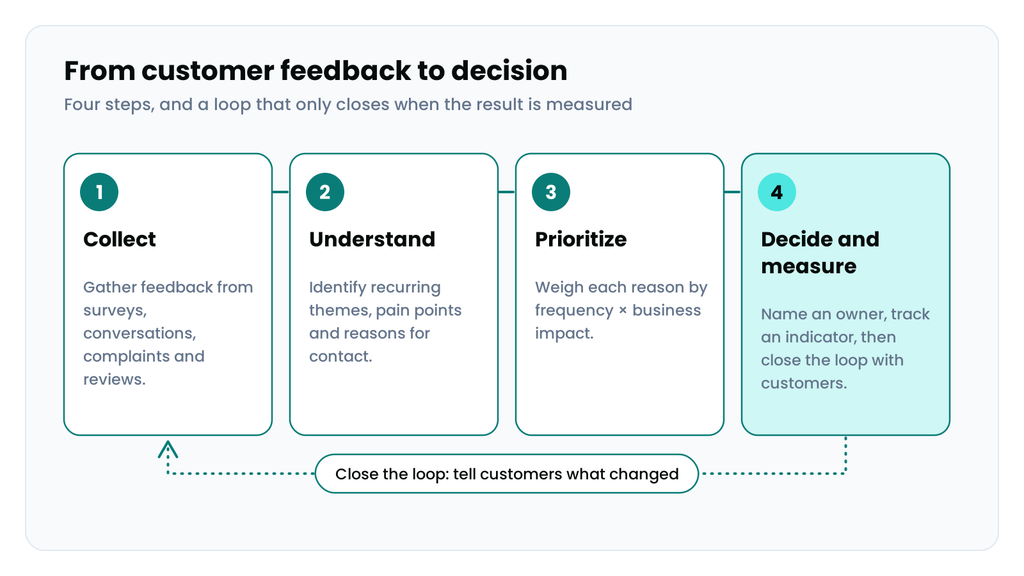
Going from customer feedback to decision generally follows four steps.
1. Collect. Gather the feedback available across the sources you cover: surveys, conversations, complaints, reviews. In our example, that means access to CSAT surveys, complaint tickets and call transcripts for the product concerned.
2. Understand. Identify recurring themes, pain points and reasons across that feedback. This is where analysis reveals that one specific reason, a refund procedure customers misunderstand, appears disproportionately in the complaints tied to the CSAT drop.
3. Prioritize. Assess the real weight of the reason by combining two criteria: its frequency (how many customers are affected) and its business impact (effect on retention, urgency compared with other reasons under analysis). This frequency × impact matrix keeps you from fixing the most visible issue first instead of the most costly one.
4. Decide and measure. A decision is made (in our example, fix the refund journey), with a named owner and a tracking indicator. The loop only closes when the change in complaints and CSAT on that product is actually measured after the fix, not just when the decision is taken. One last step, often neglected, completes the loop: telling the customers concerned that their feedback led to a concrete improvement. This is called closing the loop, and it is this step, more than the fix itself, that makes customers feel genuinely heard.
A Voice of the Customer program that stays in a dashboard without ever changing a decision has not achieved its goal, however many indicators it displays.
What AI really changes: from collection to understanding
A satisfaction survey says a customer is unhappy. It rarely says why, beyond a score or an isolated comment. Historically, understanding the “why” at scale meant manually reading hundreds of verbatims, a slow exercise rarely done beyond a sample.
Automated verbatim analysis changes that equation. It can process all the feedback sent to the tool, across connected sources, and surface the most frequent themes with their real weight rather than an impression. The question changes from “how many customers are unhappy?” to “why are they unhappy, and on which specific topic?”.
This shift does not remove the need for human reading of the most significant cases. It changes the scale at which that reading becomes possible: an analyst who used to pick a sample can now start from all available feedback and focus attention where the automated analysis has flagged a theme worth digging into.
It also changes when the company acts. Historically, a technical problem was discovered when the first calls reached support, meaning after customers had already experienced it. With continuous analysis of signals (unusual contact volumes, emerging keywords in tickets), it becomes possible to detect an emerging problem before it triggers a call spike, and to act proactively, for example by informing affected customers before they ever need to contact support.
How do you roll out a Voice of the Customer program?
1. Map existing sources before adding new ones. Most companies already have more customer feedback sources than they think. The first step is often to inventory what exists rather than launch a new survey.
2. Connect before you analyze. Linking these sources in one analysis space means bringing them together, normalizing them into a comparable format, and making it possible to cross-reference them. This is what enables the detection of cross-cutting patterns, as in our example. Simply displaying several dashboards side by side is not enough.
3. Define who receives what. An insight that is only read by the quality team has not done its job. Identified patterns must reach the teams who can act on them: product, marketing, operations.
4. Close the loop on decisions. A mature program tracks not only the signals detected but also what was done with them, to check that the cycle really closes, as in the last step of the example above.
What are the limits of a Voice of the Customer program?
- Structural representativeness bias. Customers who answer a satisfaction survey do not necessarily represent the whole customer base, especially customers who leave silently without ever complaining. Cross-referencing several sources partly offsets this bias, but does not eliminate it.
- Categorization remains a human choice. An AI that categorizes verbatims applies categories defined beforehand. Poorly designed categories produce a distorted view, even on a complete dataset.
- The risk of a dashboard with no decision. Multiplying indicators and charts does not guarantee that a decision follows. The sign of a working program is not a rich dashboard, it is the number of decisions that can be traced back to it.
- Confidentiality of sensitive feedback. Verbatims can contain personal information. Three distinct issues arise: the confidentiality of the content itself, access management within the organization, and the processing rules that apply depending on the nature of the information. Anonymization helps with the first, but does not on its own solve access management or regulatory compliance as a whole.
These limits do not undermine the value of a structured VoC program. They explain why the strongest programs keep clear governance over how insights are shared, and human oversight over how identified patterns are interpreted.
How do you choose a Voice of the Customer solution?
Before choosing a solution, check three points: which sources it can actually connect (and which remain out of scope), what “centralize” means concretely for it (ingesting data, normalizing it, cross-referencing it, or only displaying it side by side), and how it lets you track not only the insights detected but also the decisions made from them.
A solution like SquAire Insights Management aims to connect these feedback sources for cross-analysis, rather than a simple display separated by channel.
Key takeaways
- The problem is almost never a lack of customer feedback. It is the missing link between that feedback and a decision.
- Voice of the Customer differs from quality monitoring by its scale: it aggregates several sources for a business decision, not one conversation for individual coaching.
- An insight is not an isolated verbatim. It is what you get by connecting several signals.
- Moving from feedback to decision takes four steps: collect, understand, prioritize, decide and measure.
- A Voice of the Customer program is judged by its decisions, not by the richness of its dashboard.
FAQ
What is Voice of the Customer?
Voice of the Customer is the set of feedback customers express across channels (surveys, reviews, complaints, conversations), organized to guide business decisions rather than simply archived.
What is the difference between Voice of the Customer and quality monitoring?
Quality monitoring evaluates an individual conversation to produce a quality score and coaching for one agent. Voice of the Customer aggregates signals from several sources to answer a company-level question, not an agent-level one.
What is the difference between a verbatim and an insight?
A verbatim is raw data: an isolated comment or remark. An insight is what you get when you connect it to other signals (frequency, impact, correlation with another indicator), which makes it usable for a decision.
How do you analyze customer verbatims at scale?
By automating categorization and sentiment analysis across all the feedback sent to the tool, instead of manually reading a sample. Recurring themes then surface with their real weight.
Which biases should you watch for in a Voice of the Customer program?
The main one is representativeness bias: customers who answer a survey do not necessarily represent those who leave without complaining. Cross-referencing several sources partly offsets this bias.
What does “closing the loop” mean in Voice of the Customer?
It means telling customers that an improvement was made as a result of their feedback. This step, often neglected once the internal fix is done, reinforces the feeling of being heard and separates a mature VoC program from a simple listening exercise.
Go further
Want to move from scattered customer feedback to an understanding you can act on? Discover SquAire Insights Management, the SquAire module dedicated to analyzing and centralizing customer feedback to inform product, marketing and operational decisions.