

Key takeaways
- A good NPS or CSAT score does not guarantee a consistent experience: you can measure accurately and still be fragmented from one channel to the next.
- A frequent irritant does not come from the quality of one channel taken separately, but from the loss of context between channels.
- A customer who has to explain their situation again at every new touchpoint has a bad experience, even if each interaction went well on its own.
- Omnichannel is not about being present on every channel. It is about channels that remember each other.
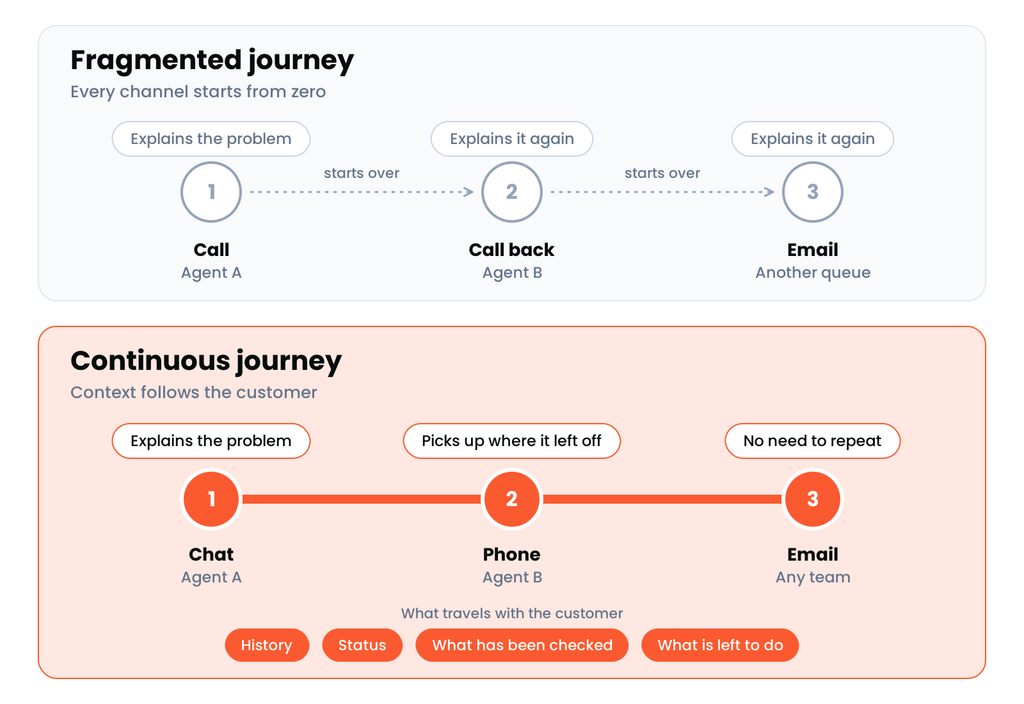
A customer calls customer service about a delivery problem. Two days later they call again because nothing has moved, and have to explain the whole situation again to another agent who has no context from the first call. They finally write an email, which lands in yet another queue. Each interaction taken separately may have been handled correctly, politely and on time. The overall experience, though, was bad.
A company can also invest in a new channel without improving its customer experience. If that channel does not share context with the others, it has simply added one more touchpoint to an already fragmented journey, without solving the problem.
What is omnichannel customer experience?
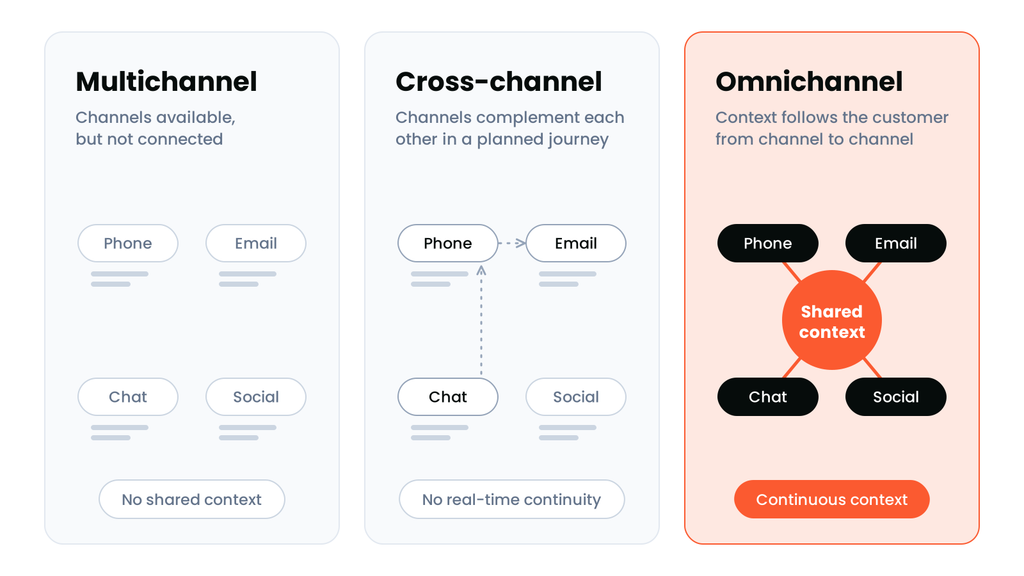
Customer experience is the overall perception a customer forms of a company through all their interactions, whatever the channel used. Three levels are usually distinguished: multichannel (several channels available, with no link between them), cross-channel (channels that complement each other in a journey designed in advance), and omnichannel (an integrated experience where context follows the customer from one channel to another in real time). Most companies today are multichannel or cross-channel without realizing it, believing they are omnichannel.
It is also not the same thing as Voice of the Customer or quality monitoring. Voice of the Customer analyzes what customers express in order to inform business decisions. Quality monitoring assesses the quality of a conversation in order to coach an agent. Customer experience is measured at the level of the whole journey.
One problem, two experiences
Fragmented journey: the customer calls, explains the problem, and the agent starts a diagnosis. The customer calls back the next day, reaches a different agent, has to explain everything again, and the diagnosis starts from scratch. The case goes back into a new queue, as if it were a new request.
Continuous journey: the customer switches channel, but the request keeps its history, its status, what has already been checked, and what is left to do. The agent who picks up the case knows what was promised to the customer and does not need to start over from the initial diagnosis.
The difference between the two is not the number of channels, or even the quality of each one taken separately. It is what flows, or does not flow, between them.
Which metrics measure customer experience?
Three metrics come up most often. NPS (Net Promoter Score) measures the likelihood to recommend at a given moment, and is often used as a proxy for the overall relationship. CSAT (customer satisfaction score) measures satisfaction right after a specific interaction. CES (customer effort score) measures the effort the customer had to make to solve their problem. A high CES can point to friction caused by a loss of context, but not only: it can also reflect the inherent complexity of a request. It is a signal to investigate, not direct proof.
Taken separately, none of these three metrics shows where a break might be. The diagnosis becomes concrete when you combine them with journey data: how many times a case was reopened, how many transfers it needed, how much information the customer had to repeat.
How do you identify a break in the customer journey?
A break in the journey shows up when context does not follow the customer. The agent does not only need to see the history of past exchanges. They need to know what has already been checked, what was promised to the customer, what is left to do, and who is responsible. When any of these has to be asked again even though it was already established, that is the sign of a break.
The rate of channel switching during resolution is a useful indicator, as long as it is read with nuance: switching channel is not always a failure, and a customer may deliberately prefer to move from chat to phone for a complex topic. What should raise a flag is not the switch itself, but the fact that context does not follow it.
What a fragmented experience costs
A break in continuity is not just an inconvenience for the customer. It has a direct operational cost: a case handled twice, a diagnosis redone from scratch, an extra transfer, a complaint opened because the customer had to repeat themselves once too often. Each of these means agent time spent handling again a problem that was already underway, not a new request. This hidden cost, more than the discomfort felt by the customer, is why an operations or customer relations leader should take ownership of continuity, not only a marketing or CX leader.
How to build a consistent customer experience
- Map the real journey, not the theoretical one. The journey designed on paper and the one customers actually live often differ, especially at the transition points between channels or teams.
- Unify data before adding a channel. Adding a new channel without connecting its history to the existing channels recreates the same fragmentation problem you were trying to solve.
- Prioritize transition points, not just individual channels. A channel can work very well on its own and still create friction at the exact moment a customer switches.
- Measure continuity, not just one-off satisfaction. Tracking reopened cases, transfers and repeated information gives a view of overall consistency that a CSAT after a single contact does not capture.
Continuity therefore does not depend on tools alone. If each team keeps its own history, its own goals and its own metrics, customers will keep experiencing several conversations where they believe they are having only one.
What are the limits of a customer experience approach?
- Metrics without action. Adding more metrics without turning them into concrete decisions leads to the same pitfall as with Voice of the Customer: a rich dashboard that changes nothing about the real journey.
- The risk of over-personalization. Trying to remember everything about a customer can feel like surveillance rather than service, if personalization is not applied with care.
- The organizational silo behind the technical silo. Connecting tools is not enough if teams are still assessed separately by channel, with no shared goal on journey continuity. Cross-functional steering committees, and agents trained across several channels instead of confined to one, help limit this pitfall, though technology alone will not solve it.
- The single-metric bias. Steering on an aggregate NPS alone hides major gaps between customer segments or between channels, which only show up at the level of the individual journey.
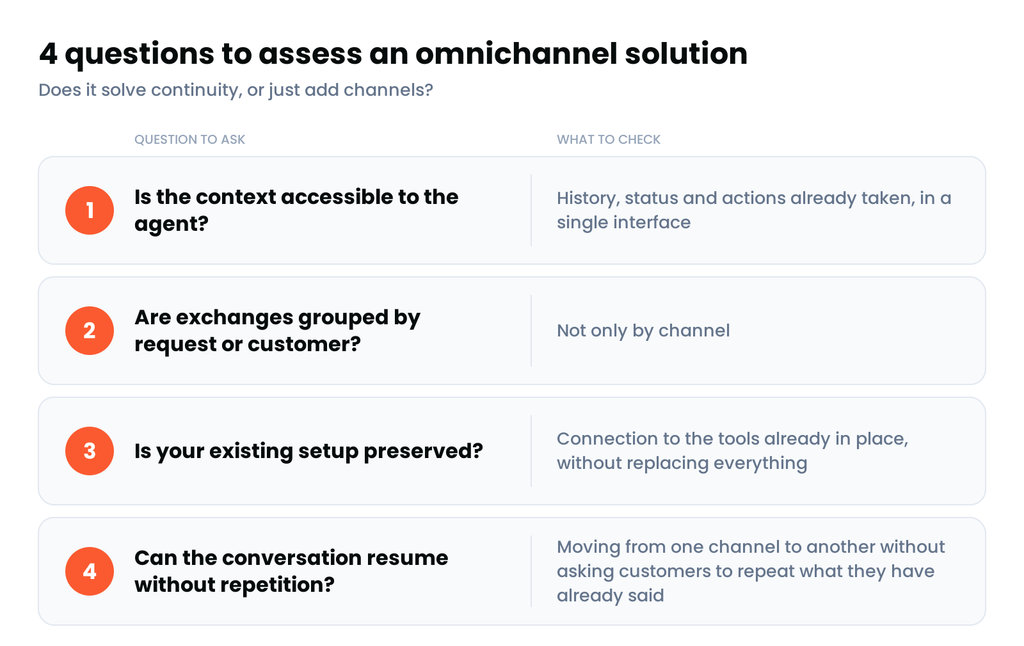
How to evaluate an omnichannel customer experience solution?
| Question to ask | What to check |
|---|---|
| Is the context accessible to the agent? | History, status and actions already taken, in a single interface |
| Are exchanges grouped by request or customer? | Not only by channel |
| Is your existing setup preserved? | Connection to the tools already in place, without replacing everything |
| Can the conversation resume without repetition? | Moving from one channel to another without asking customers to repeat what they have already said |
That is precisely the role of an interaction management module: making sure that moving from one channel to another does not start a new conversation, but continues the existing one. SquAire Interaction brings all channels into a single interface that collects, links and records the content of every interaction, whatever the channel used. It also turns business processes into handling journeys that guide the agent at every step, instead of leaving them to rebuild the context alone. The solution connects to the business applications already in place, without requiring a full replacement, and steers continuity through indicators shared across departments: resolution rate, NPS, handling time and perceived quality.
At Monoprix, an Armatis client on this topic for many years, the feedback points the same way: “A real know-how, built together with Armatis, that has made technology step back so the relationship with our customers comes first” (Patrick Guimet, Head of Customer Relations, Monoprix). That is exactly the challenge of omnichannel continuity: technology should serve the journey without ever becoming an extra obstacle itself.
Key points to remember
To diagnose the continuity of an omnichannel journey, three things are worth observing: what the customer has to repeat, what the agent cannot see at the moment they need it, and what gets lost at the exact point of switching channels. It is this loss of information at transition points, more than the quality of each channel taken separately, that determines whether a journey is truly omnichannel or merely multichannel.
FAQ
What is omnichannel customer experience?
It is an experience where context (history, request status, identity) follows the customer from one channel to another, as opposed to multichannel (channels available but not connected) or cross-channel (complementary channels but without real-time continuity).
What is the difference between omnichannel and simply being present on several channels?
Being present on several channels does not mean they talk to each other. Omnichannel means the context of a request (history, status, actions already taken) follows the customer from one channel to another, not just that each channel is available separately.
What is the difference between NPS, CSAT and CES?
NPS (Net Promoter Score) measures the likelihood to recommend at a given moment. CSAT (customer satisfaction score) measures satisfaction after a specific interaction. CES (customer effort score) measures the effort a customer had to make to solve their problem.
How do you measure the continuity of a customer journey?
Continuity cannot be measured with a single metric. Satisfaction and perceived effort need to be combined with journey data: channel switches, repeated information, transfers, reopened cases and the time needed to resolve a single request.
How do you spot a break in the customer journey?
By identifying the moments when a customer has to give again information they have already provided, usually when switching channel or contact.
What is the difference between customer experience and Voice of the Customer?
Voice of the Customer analyzes what customers express in order to inform business decisions. Customer experience is measured at the level of the whole journey, through indicators such as CES and continuity between channels.
Go further
Want to stop your customers starting over every time they switch channel? Discover SquAire Interaction.